
Jefferson County Property Tax Record Fields
The Jefferson County parcel page gathers assessment and tax data on one screen. Land, improvement, and total assessed value sit apart. Below them come tax year and district. General Taxes, First Dollar and Lottery Credit rows follow. Installment amounts, paid and balance columns, and a tax total round out the page. Tax Detail, Payoff Statement, and Payment History open related views. The tax collector portal runs a separate bill search. Check the year and parcel number on every result. A bill and an assessment field can point to different cycles.
| Field | What It Shows | Where |
|---|---|---|
| Assessed land / improvements | Separate assessed amounts and total value | County parcel card |
| Assessment year | Current and prior assessment-year values | County parcel card |
| First Dollar / Lottery Credit | Credit rows shown with taxes | Parcel tax information |
| Installments and balance | Paid, due, and remaining amounts | Tax Detail / Payment History |
| District information | Taxing district codes and descriptions | Parcel card and tax portal |
A parcel card may also list an average assessment ratio and an estimated market value. Both are assessment outputs. Neither is a private appraisal or a recorded sale price. A transfer list can show an amount for one deed and none for another, so read the sale document, assessment year, and tax bill as separate entries.
Finding a Jefferson County Tax Bill
The tax collector search takes four keys: Property Owner's Name, Location House Number/Street Name, Property Number, or Tax Bill Number. Roll Type and Tax Year selectors narrow results. For an owner search, enter only a last name. For a street query, enter only the street name. Those tips come from the site's own instructions. Once the parcel card is open, Tax Detail, Payment History, and Payoff Statement connect the bill view back to the land record.
- Choose a search key and enter the tax year and roll type if known.
- Match the returned property number to the Jefferson County parcel card.
- Read the installment, paid, balance, credit, and district rows for that year.
- Call the Treasurer about a current payoff or an older delinquent balance.
- Assessed value
- The value placed on land and improvements for the local tax roll.
- Average assessment ratio
- A comparison used to estimate market value from assessed value.
- First Dollar Credit
- A named credit row shown in parcel tax information.
- Delinquent balance
- An unpaid tax amount that should be confirmed with the Treasurer.
Reviewing a Jefferson County Assessment
Current values can shift until Board of Review adjournment. Nothing is final before then. Wisconsin's 2025 Property Assessment Manual update covers assessment cycles, open-book and Board of Review guidance, mass appraisal, and agricultural assessment. Check the parcel's assessment years and the municipality's ratio. Only then ask how a value was set, since a sale amount and an assessment serve different purposes on different dates.
Review timing. The research does not establish one county-wide appeal deadline. Use the notice for the parcel's municipality and confirm open-book and Board of Review dates with the assessor before filing.
Jefferson County Property Tax Search Fields
Each key on the tax collector form fits a different bill lookup. Copy a property number or tax-bill number straight from a prior statement. The street field works when only the road is known. An owner search can return several properties. Narrow it with tax year and roll type. For matching an address to a parcel first, the county's separate parcel search is the better source. Pick the tax record after that match is firm.
| Visible Field | Purpose | Practical Note |
|---|---|---|
| Property Owner's Name | Find tax accounts by name | Search last name only first |
| Location House Number / Street Name | Find a bill by site address | Street-only searches can list a block |
| Property Number | Direct account match | Compare to parcel card |
| Tax Bill Number | Open a known bill | Copy digits from the statement |
| Roll Type / Tax Year | Limit the record set | Check the year on the result |
These fields are shown on the Jefferson County tax collector search.
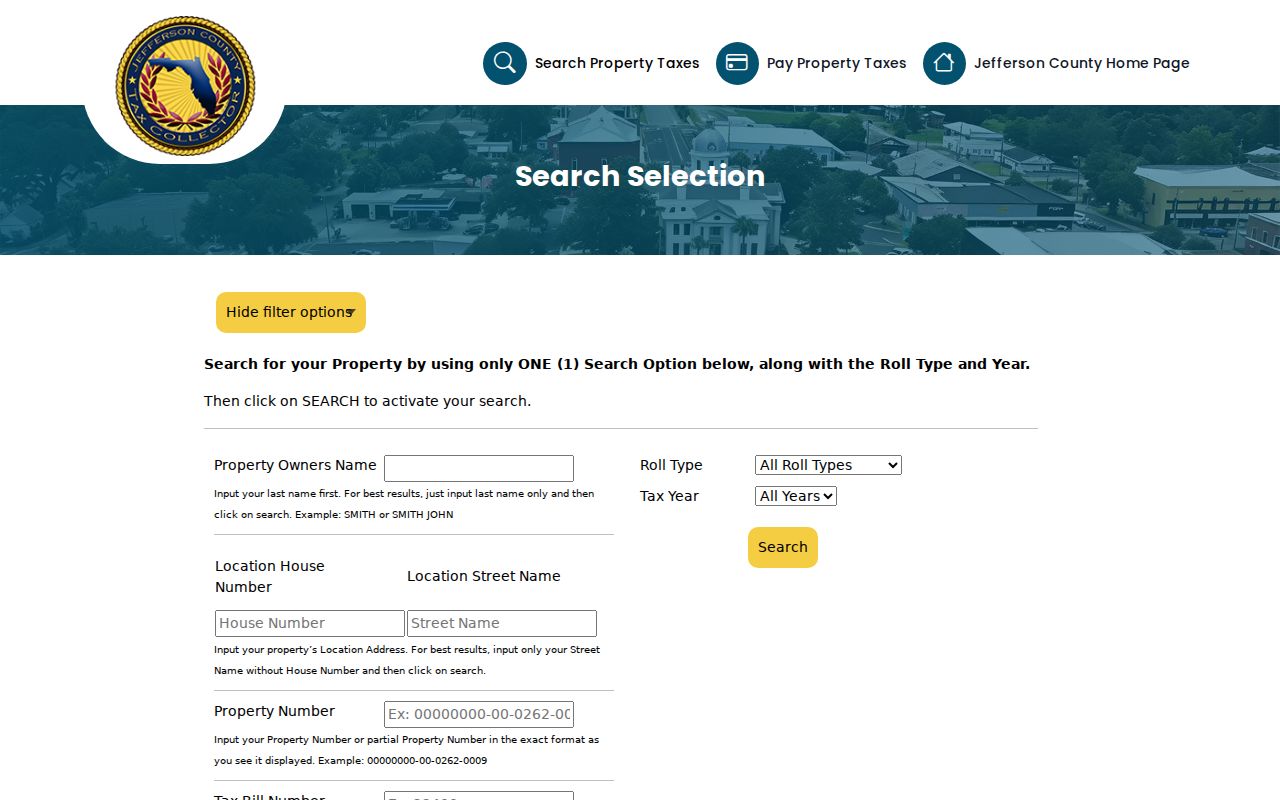
A tax-bill number pulls one account; the street field covers a whole block.
Jefferson County Assessment Years and Ratios
Jefferson County parcel cards can display both 2026 and 2025 assessment values. The average assessment ratio sits beside them. Updates typically post in late August or September. Read the year beside each number.
The Wisconsin Department of Revenue publishes municipal aggregate ratios and state assessment reports. The Wisconsin DOR assessment reports offer municipality-level context. A ratio compares a municipality's tax roll with its estimated market value, but no ratio works as an appraisal for one parcel. A county card may show an estimated market figure, while the transfer list carries selected sale amounts.
Compare like years and keep the parcel number. Check the current assessor notice too. Current-year values remain subject to Board of Review final adjournment.
The Jefferson County parcel value example shows the assessed components, ratio, estimated market value, taxes, and sale history together.
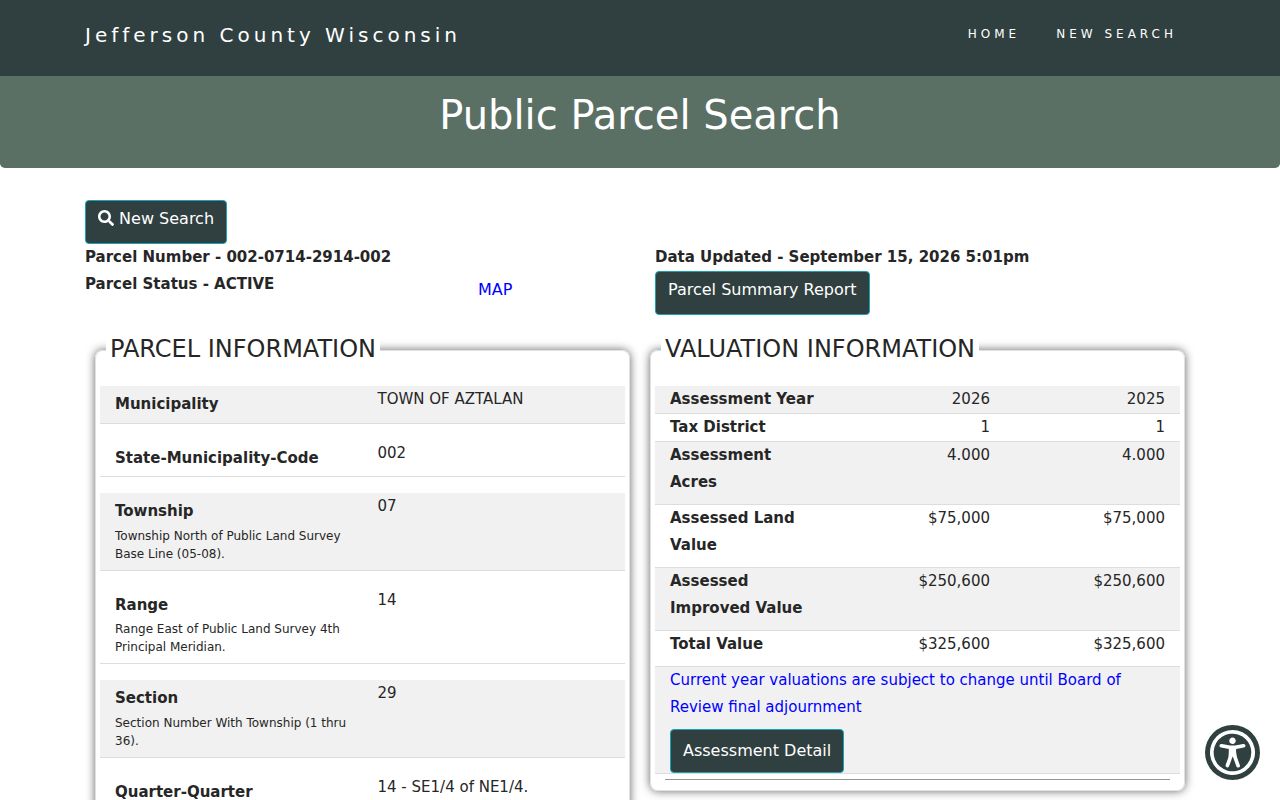
Each field on the card needs its own read.
Jefferson County Property Tax Credits and Installments
The tax rows carry plenty of detail. First Dollar and Lottery Credit entries appear there, along with installment amounts, paid and balance columns, and a total. District codes cover school and technical-college areas. Those Jefferson County property tax records help you match a bill against payment history or ask the Treasurer about a remaining amount.
Credits can change from year to year. Match the tax year and account before comparing totals. A credit changes the bill calculation, not the recorded sale price or the assessed land and improvement amounts. If an installment posts after the portal refresh, ask the Treasurer which receipt or payment entry controls.
The card includes Tax Detail, Payoff Statement, and Payment History controls. A payoff figure has a validity date. Use it only for the stated period.
Jefferson County Property Tax Delinquency and Payoff Checks
A parcel page flags the account as delinquent or not delinquent. It also shows the payoff date behind the displayed amount. The Treasurer's phone number sits right on the card. The BillingDoc portal handles current-year balances and payments. Prior-year delinquency questions go to the office itself. Treat any portal balance as a snapshot, not a standing payoff quote.
Before closing a transaction or estate file, pull the current payment history. Ask for an updated payoff figure too. A tax claim that turned into litigation leaves a trail in WCCA. You can reconcile that trail against the parcel card and recorded deeds. The county publishes no standalone online tax-sale list. Rely on official county notices or a written request when sale status matters.
Keep the distinctions straight. A delinquent-tax flag is not a recorded lien, and neither one equals a completed sale. Court filings and deed records often reveal steps the tax panel never displays.
Jefferson County City and County Tax Roles
The same Jefferson County property can show up in two places with two different jobs. Jefferson's city tax page posts current and prior real-estate bills and notes that the second installment flows to Jefferson County. The city may collect the first installment itself. Meanwhile the county parcel card carries assessment data, transfers, permits, and the county tax rows.
Reconciliation is the fix. Match the parcel number and tax-bill number across the city page, the tax collector, and JCLRS. A city name or ZIP label alone never proves who actually custodies the tax, which matters most in Watertown and Whitewater, both of which straddle county lines. Confirm the municipality and county before anything else.
That routing step sends a payment question to the right treasurer rather than the assessor.
Older Jefferson County Tax Records
Online parcel cards reach back only so far, covering current and prior assessment years. They offer no complete historic run of tax bills. Older roll books and payment records usually live with the county or municipal custodian. A request is the way in. Wisconsin's Open Records Law governs these public records, subject to statutory limits and the public-interest balancing test. It sets no fixed response deadline.
Write the request with precision. Name the parcel, the bill year, the record type, and the format you want. A custodian may charge actual, necessary, direct costs for locating, copying, photographing, or mailing records. Under DOJ guidance, a locating fee applies only when that cost reaches $50. The office must give notice before proceeding. Court and Register of Deeds charges follow separate rules.
For live tax questions, start with parcel Tax Detail and the tax collector. Route older delinquency or payoff issues to the Treasurer. Municipal historic bills belong to the municipality itself.